Several months ago I interviewed Hannu Lintu, now in his second full season as Chief Conductor of the Finnish RSO. Me being me, and knowing that Lintu is a very adventurous conductor, I brought my score of Pettersson 15 to the interview. After the interview we listened to the symphony for a few minutes, score in hand.
He was in a hurry, but closed the score and said something to the effect of (I cannot remember precisely):
"We need to do more things like this."
I was of course very excited to hear that. I decided to ask my contacts at Gehrman's if a score of Pettersson 15 could be provided for Lintu. They agreed.
Last night was the opening concert of the Finnish RSO 2014-2015 season. After the concert I met Lintu backstage, and gave him the score. He seemed quite excited, and said that a lot of 2015-2016 is still open.
Finland has actually produced a number of Pettersson enthusiasts, most notably Leif Segerstam. In recent years Jan Söderblom has performed both the Symphony No. 7 and Concerto No. 1 for String Orchestra in Tampere and Helsinki, repectively. Söderblom is now concertmaster of the Helsinki Phil, and has expressed interest in performing the Concerto No. 2 for Violin and Orchestra as soloist. And let's not forget Annemarie Åström, the formidably talented violinist who was the soloist in last year's Helsinki performance of the Concerto for Violin and String Quartet.
So, will we be hearing the Symphony No. 15 in Helsinki next year? I certainly hope so! Keep your fingers crossed.
Showing posts with label Miscellaneous. Show all posts
Showing posts with label Miscellaneous. Show all posts
Wednesday, September 3, 2014

Tuesday, April 8, 2014
The subjectivity of "pure information"

This was the title of a talk that I recently gave at the Arkadia International Bookshop in Helsinki.
Arkadia is a popular place for both expats and locals alike. Besides the friendly staff, Arkadia also features a calendar full of diverse events: recitals, poetry readings, film showings, discussions on politics and philosophy, and more. Basically, if you have anything interesting to share, just ask the owner and most likely Arkadia will provide the stage for you.
I had been asked to talk about my day job, but I assumed that there were enough people in Helsinki willing to talk about microbiology, but finding people willing to talk about Allan Pettersson would be considerably more challenging. But you can count on me to take up the task.
On 22 March 2014 the city of Helsinki was blessed with something it does not get terribly often: beautiful, sunny weather. I was scheduled to give my presentation at 16.00 in the windowless basement of Arkadia. After being enthusiastically welcomed by the Arkadia staff upon my arrival, I was warned that I would be competing against this beautiful weather!
I managed to draw in six audience members. Three I already knew personally, and one I believe was an employee of the bookstore. In other words, two people saw the announcement and decided on their own volition to spend a little time indoors with me and Pettersson's Symphony No. 10. An unbeatable combination, no doubt?
The audience then listened to the Segerstam recording of the Symphony No. 10. In an ideal world I should have played it louder, but there were other events going on in the store, and I was not sure what would be the tolerance level of the audience.
After the piece concluded I began a discussion with the audience. I asked them to share their immediate feelings on the piece. Initially, I had to guide the discussion towards how the work made them feel, instead of just describing the music (fast, loud, etc.). Although some people continued to just give descriptions of the music, some responses were nevertheless quite interesting. Here is what I wrote down, exactly as I wrote it:
- Odd, bored, active stasis
- Military marches
- Constant sense of moving forward, not always pleasant
- Constant confrontation, a battle, trying to go to a resolution, strings vs. horns, at the end, they move together
- More visual than aural, scattered puzzle pieces
While most of the above I can understand, I never thought I would hear someone say that this music is boring! When asked for further clarification, it was simply that this music didn't do much for him. Fair enough.
I then shared with the audience some of Pettersson's more famous quotes, namely the "blessings" and "curses," as well as the "pure information" response to being accused of putting self-pity into his music. I also talked about the biographical circumstances of the composer's life at the time the Symphony No. 10 was composed.
Having said all this, I then asked if this information had changed their opinion on the music; did the music make more "sense" now. I got about an even split among the audience: knowing this about Pettersson made no difference, while others said it aided in their understanding of the work.
I was asked about what I thought is the "pure information" that makes up Pettersson's music. I said I believed that when Pettersson set about writing a work, he first established a group of motives, gestures, intervals, etc, upon which the work will be based. This in itself does not mean or represent anything, it is just "pure information." Not sure how accurate or satisfactory that answer was.
I was also asked about why I was so attracted to Pettersson's music and why I chose the Symphony No. 10. I said that Pettersson's music expresses the human condition with an unflinching honesty that words (or even other art forms) cannot describe. I told them that Pettersson's music can take you to places of the purest beauty, of almost enlightenment, but it will not be an easy journey. You have to climb the mountain. If you can make it to the top, you will be rewarded.
My decision to use the Symphony No. 10 as an introduction to Pettersson's music was both practical and musical. I didn't want to make the audience sit for 45 minutes, which would have happened if I played the Symphony No. 7. I also chose the Symphony No. 10 because of its immediate impact--it is not a viscerally ambiguous piece.
I concluded the discussion by playing the beautiful string chorale from the Comissiona recording of the Symphony No. 7. I was immediately asked to come back again in the future to give another talk. I thought about giving the same presentation again, since so few people showed up this time. Or what are some other things about Pettersson that I could share with a "virgin" audience? Hmm...
Wednesday, January 8, 2014
Concert Review: Concerto for String Orchestra No. 1
Dear Friends,
Apologies for the long delay, as this concert took place on 15.11.2013!
One of the most pleasant surprises which I had shortly after moving to Helsinki was looking at the then just-released Spring 2008 calendar of the Tampere Philharmonic. In January 2008 this orchestra programmed the Symphony No. 7. On the podium was the violinist-conductor Jan Söderblom, somebody I had not heard of before. It was the first time I heard Pettersson live in concert, and it was a memorable performance. As for Söderblom, I made a mental note to check his performance schedule regularly, because more Pettersson could be coming from this source...
More than 5 years later, Söderblom conducted the Tapiola Sinfonietta (an excellent full-time chamber orchestra based in west Helsinki) in a performance of the Concerto for String Orchestra No. 1, the subject of this review.
As I've probably mentioned before, every time I hear/see Pettersson live in performance I realize just how difficult this music is to play. About a year before this concert, I saw the same piece performed in Berlin, and the difficulties of the music appeared to overwhelm the musicians at times. Having seen the Tapiola Sinfonietta many times over the years, I am thoroughly familiar with their amazing ability and was looking forward to this concert.
Söderblom led the piece from the concertmaster's chair. The first thing which struck me was the tight ensemble and extra-sharp articulations from the violas, who open the piece with repeated-note stabs. The entrance of the violins, with that motive based on fourths and fifths, came across as being a bit too cautious, instead of the storm of rosin I was hoping for. This was a general impression I had of this movement.
While the contributions from the first desk players were excellent, in addition to the sense of cautiousness there were several transitional passages in the first movement which could have used a little more rehearsal.
The second movement went about as well as I could have imagined. The opening "sigh" in e minor was chillingly played, the repeated notes were played with such maniacal insistence that they became almost disturbing, and the broad, quasi-Mahlerian section in Db/C# was extremely effective.
The final movement went well, but again I felt that there was a certain sense of cautiousness. I'm so used to the final pages being taken relatively slowly, where the music is searching, falling into eb minor. As I've never seen the score, I do not know what tempo indication Pettersson had in mind. In this performance, the final measures went by pretty quickly, similar to Lindberg's take. Since Lindberg does such an incredible job of conducting exactly what Pettersson writes, I'll assume that Söderblom was doing the same.
Overall a great performance, and maybe another rehearsal would have made it amazing.
So, what Pettersson will Söderblom perform next? Hopefully it will be sooner than five years from now...
Sunday, November 3, 2013
Norrköping 2013: Concert Review!
I am not sure if my non-American readers know of the children's story called The Little Engine That Could. It is basically about a small engine who managed to pull an entire train over the hill. Larger, stronger engines refused this task, leaving it to the small one. As the small engine struggles to climb to the top of the hill, he never gives up, repeating to himself "I think I can, I think I can." I had this image in my mind while listening to this Norrköping SO concert featuring not one, but two Pettersson symphonies. As you probably know by now, the NSO is not just performing Pettersson regularly, but they will also record the rest of the symphonies not yet recorded for BIS. The larger, stronger "engines" (uh, let's call them the Göteborgs SO and RSPO and SRSO) have refused, but here the little engine steps up and accomplishes the task which others think is impossible.
On to the concert then. The evening began with the Symphony No. 16, a work which I still feel is quite elusive and not as effective as its predecessors. I was quite impressed with the orchestra, who seemed to be more comfortable with this extremely busy and densely scored music when compared to the Symphony No. 4. The soloist, Jörgen Pettersson, was in complete control of this music and put passion and energy into every note. It really does make a difference when Pettersson's markings and dynamics are followed literally, which is what happened here. Bravo!
The fast and loud music (such as the first and third sections) were visceral and exciting and the slow music was beautifully played, but I still cannot get into this piece. I have no doubt in my mind that when the recording is available, it will be the most convincing argument to date for this work.
On to the main course, the Symphony No. 4. In my opinion this is, at least on the surface, one of Pettersson's most accessible symphonies. However, it feels like a transitional work between his early and middle orchestral styles. Although the orchestra seemed to struggle a little in the morning rehearsal the evening performance was in a different league. During the concert, I could feel the intensity of concentration and the results were a testament to this orchestra's professionalism and commitment. It goes without saying that Christian Lindberg lives this music and his conducting reflects this.
I was a little surprised how empty the hall seemed--I think the performance of the Symphony No. 9 last year was better attended. However, it is quite likely that the people who were present really wanted to be there, and they listened with the requisite concentration. The response was very enthusiastic for both symphonies.
I heard that the orchestra had only three rehearsals for this program. Although the performance felt like a work still in progress, convincingly performing two Pettersson symphonies on one program is superhuman, and Christian Lindberg and the NSO should be praised for their incredible physical and emotional stamina. While I felt that the performance of the Symphony No. 6 two years ago also felt like a work in progress, we all know how absolutely amazing and enlightening the recording is. I have no doubt in my mind that when this program is released on CD the results will be equally stunning.
Way to go guys!
PS. Some extra details: for the Symphony No. 16 the performance time was about 27 minutes, Pettersson marks in the score 25 minutes.
For the Symphony No. 4 the performance time was about 38 minutes, Pettersson marks in the score 35 minutes.
Norrköping 2013: Rehearsal, Press Conference, Vox Humana, and Post-Concert
It is now becoming an established fall tradition that I wake up at an ungodly hour in darkness and under grey skies to fly to Sweden, where I am greeted by more grey skies. That's right, the yearly trip to Norrköping, Sweden, to watch Christian Lindberg and the extremely hard-working Norrköping band as they continue to work their way through the Pettersson symphony cycle.
This year, however, was different. I wasn't just attending a concert, but there was practically a whole day of activities dedicated to Pettersson ahead of me. I arrived at the concert hall at approximately 10:30, where after asking around a little bit I was escorted into the dress rehearsal. At this time, the orchestra was drilling a few more passages in Lindberg's Kundraan and the Arctic Light, before moving on to the Pettersson works. Shortly after I showed up in the hall I was greeted by Jean-Christophe of ResMusica, Markus from the German Pettersson society and Robert van Bahr of BIS.
I can seriously say that if it was not for Robert, my life would probably be dramatically different. It was because of BIS' recordings of Pettersson, Sibelius, Tubin, and Aho that I decided to take the plunge and move to Finland, where I could be "closer to the action." Robert is an extremely energetic and enthusiastic person and unfairly gifted with languages. Robert took a seat next to me as the orchestra began to rehearse the Symphony No. 4, and we followed the score together.
I was a little surprised at how difficult it seemed to put everything together, considering how the technical demands of this symphony are generally lighter in comparison to the rest of Pettersson's symphonic oeuvre. During the break Christian Lindberg enthusiastically greeted me and we discussed a few sections in the score.
After the break there was some spot-checking in the Symphony No. 4, after which the saxophone soloist Jörgen Pettersson came on stage to begin rehearsing the Symphony No. 16. I've made it pretty clear on this blog that I find this work to be quite problematic, starting with my personal bias against the saxophone in an orchestra context. During the rehearsal I was surprised by a number of things: I actually started to think that this piece "works," that the saxophone soloist was not completely drowned out, and that the orchestra seemed to play this work with more confidence than the other symphony on the program.
At 13:00 the much-anticipated press conference began. This was attended mostly by orchestra staff, people from BIS, and die-hard Pettersson fans like myself. I actually do not have much to write here, since the entire press conference has been uploaded to YouTube and the orchestra's plans have been outlined on their webpage as well as here. In brief, between now and 2018 Lindberg and the orchestra will perform and record all the remaining symphonies for BIS which have not already been recorded on this label. There will also be a new recording of the Symphony No. 7 which will include the Symphony No. 17, in a completion by Lindberg. In 2018 the orchestra will take Pettersson's music on tour. Furthermore, several of the new recordings will be coupled with bonus DVDs featuring old Pettersson documentaries. You can hear Lindberg talk about the project here.
Included with the upcoming release of the Symphony No. 9 is a bonus DVD of Vox Humana, the documentary film made by Peter Berggren in the 1970s. This film was shown after the press conference. Again, I won't say much here since you can see it for yourself when it is released, but I will say this: I knew Pettersson was ill, but what I saw and heard shocked me. The fact that Pettersson was able to write what he did given the circumstances only further increases my admiration of this amazing artist.
After the concert (I will post a review of the concert itself soon) Lindberg and several friends and close contacts went out for food and drinks. I was lucky enough to be seated next to Lindberg, and we enthusiastically talked about (you guessed it!) Pettersson. We also came up with a plan of action to get Pettersson performed in Helsinki, which is something I am extremely excited about.
What a day.
Wednesday, October 30, 2013
Pettersson tre gånger/Pettersson kolme kertaa
Dear Friends,
I am a very lucky person.
When I was living in the states, I resigned myself to the likelihood that Pettersson was just another one of those composers who I could only enjoy on recordings, but never in concert.
In the next 14 days, I will experience something I never thought was possible in one lifetime. In the next 14 days, I will hear three, that's right, three (tre/kolme in Swedish/Finnish) Pettersson works in concert. If you include the performance of the Concerto for Violin and String Quartet that I attended last April, that will make four Pettersson works in a little more than half a year.
Tomorrow I will be heading to Norrköping to attend a performance of Christian Lindberg and the Norrköping SO in Symphony No. 16 and 4, and on 15 November, in my adopted home of Helsinki the Tapiola Sinfonietta will be performing the Concerto for String Orchestra No. 1 under the baton of Jan Söderblom, who himself performed the Symphony No. 7 in Tampere, Finland (I was there too!) back in 2008.
Regarding Norrköping, it looks like I will have a full schedule: dress rehearsal in the morning, followed by Christian Lindberg's press conference on the Pettersson Project 2013-18. There will also be a viewing of Vox Humana, the old Pettersson documentary which will be included as a bonus DVD with the upcoming BIS release of the Symphony No. 9. In the foyer of the concert hall there will be a exhibition of Gunnar Källström's darkly intense black and white photos of Pettersson. Following the concert there are rumors of some kind of party? Throughout the day and evening I look forward to meeting with Pettersson enthusiasts who have come from near and far for this massive event.
Expect to hear my reports on all of these upcoming events and concerts in the coming weeks.
I am a very, very lucky person. I thank everyone who has made this possible!
Thursday, May 2, 2013
Nach Weimar für die Siebte!
It looks like the 2013-14 season will not be a complete bust for a live performance of a Pettersson Symphony, save for the performances of Symphony No. 4 and 16 in Norrköping. I am pleased to announce that the Staatskapelle Weimar under the direction of Stefan Solyom will be performing the Symphony No. 7 (you guessed it!) on 16 and 17 March 2014. Also on the program will be Lidholm's haunting Kontakion, so a great all-around program.
Thanks Alexander for the info on this one!
Wednesday, April 17, 2013
Inte i Stockholm eller Göteborg
In what will likely be a disappointing but predictable ritual each spring, I am writing to tell you that the major orchestras of Stockholm (both RSPO and SRSO) and Göteborg have announced their 2013-14 seasons, and they do not feature any Pettersson. It looks like for the next year you'll have to go to Finland or Norrköping, unless Malmö (or anyone else) has a pleasant surprise for us.
C'mon guys. It's not like Brahms or Mahler need more exposure.
Friday, April 12, 2013
Tykkäätkö Petterssonin musiikista? Tule Suomeen!
Dear Friends,
It appears that the year 2013 will be a good year for Pettersson in Finland, of all places. In addition to performances of the Concerto for Violin and String Quartet and Seven Sonatas, I just read today that the Tapiola Sinfonietta, an excellent full-time chamber orchestra based western Helsinki (with an amazing string section too), will be performing the Concerto No. 1 for String Orchestra on 15 November, Jan Söderblom conducting. Söderblom conducted the Symphony No. 7 in Tampere in 2008, so this guy knows his Pettersson.
Welcome to Helsinki, and let's meet!
Wednesday, January 2, 2013
Pettersson Helsingissä! (Vihdoinkin!)
Just found
out today that on 18.4.2013 there will be a performance of the Concerto for Violin and String Quartet,
put on by the Sibelius Academy. The violinist Annemarie Åström will be tackling
the fiendishly difficult solo part, supported by the Tempera Quartet.
Tervetuloa Helsinkiin!
Monday, December 31, 2012
Mitt arbete är färdigt?
Dear Friends,
Exactly two
years ago I began this blog project, my little tribute to Pettersson on his
100th anniversary year, with the intent of listening to all of his orchestral
works before his big birthday on 19 September 2011. Seeing that I just posted
my thoughts on the Symphony No. 1 just
under two weeks ago, it goes without saying that I did not even come close to
making my intended deadline.
Regardless,
during this time I have immersed myself in Pettersson’s music to a level of
depth which I have not attempted with any other composer I know. I have been
haunted, disturbed, sometimes even harassed to the point of insomnia by this
music. During this survey I have reassessed works which I had given up on in
the past, several of which now rank among my favorites. I have gained an exponentially greater appreciation of this music and the profound message that it carries.
During this time
I have had the privilege of seeing Pettersson’s music performed live. I have
performed Pettersson’s music on one of the greatest stages in all of classical
music. I have visited Pettersson's grave and his old neighborhoods in Stockholm. I have been quoted on the radio, word-for-word (unacknowledged!) by the
BBC. Christian Lindberg has visited this blog and left comments. Guest writers
have contributed to this blog, their writings insightful and often deeply
moving. Readers from all over the world have visited, from the casual to the die-hard
Pettersson fan, from the curious to those who simply stumbled upon this blog by
accident. I never expected to receive so many visitors, and I am extremely
grateful for your support and comments.
In addition
to being my tribute to Pettersson, I have hoped that this blog has and will
continue to serve as an English-language resource to this great composer.
However, having made it through all of the orchestral works, I think my work
here if finished. Having said that, I will still come back with information on
upcoming concerts, concert reviews, and hopefully more guest blog entries. If
it is Pettersson-related, I will do my best to present it here.
Keep
listening to this music. Keep studying this music. Keep spreading the word. I
sincerely hope that during my lifetime, Pettersson’s music will go the way of
Mahler: his time will come.
See you
around!
Sunday, December 9, 2012
Allan Pettersson archives, Uppsala
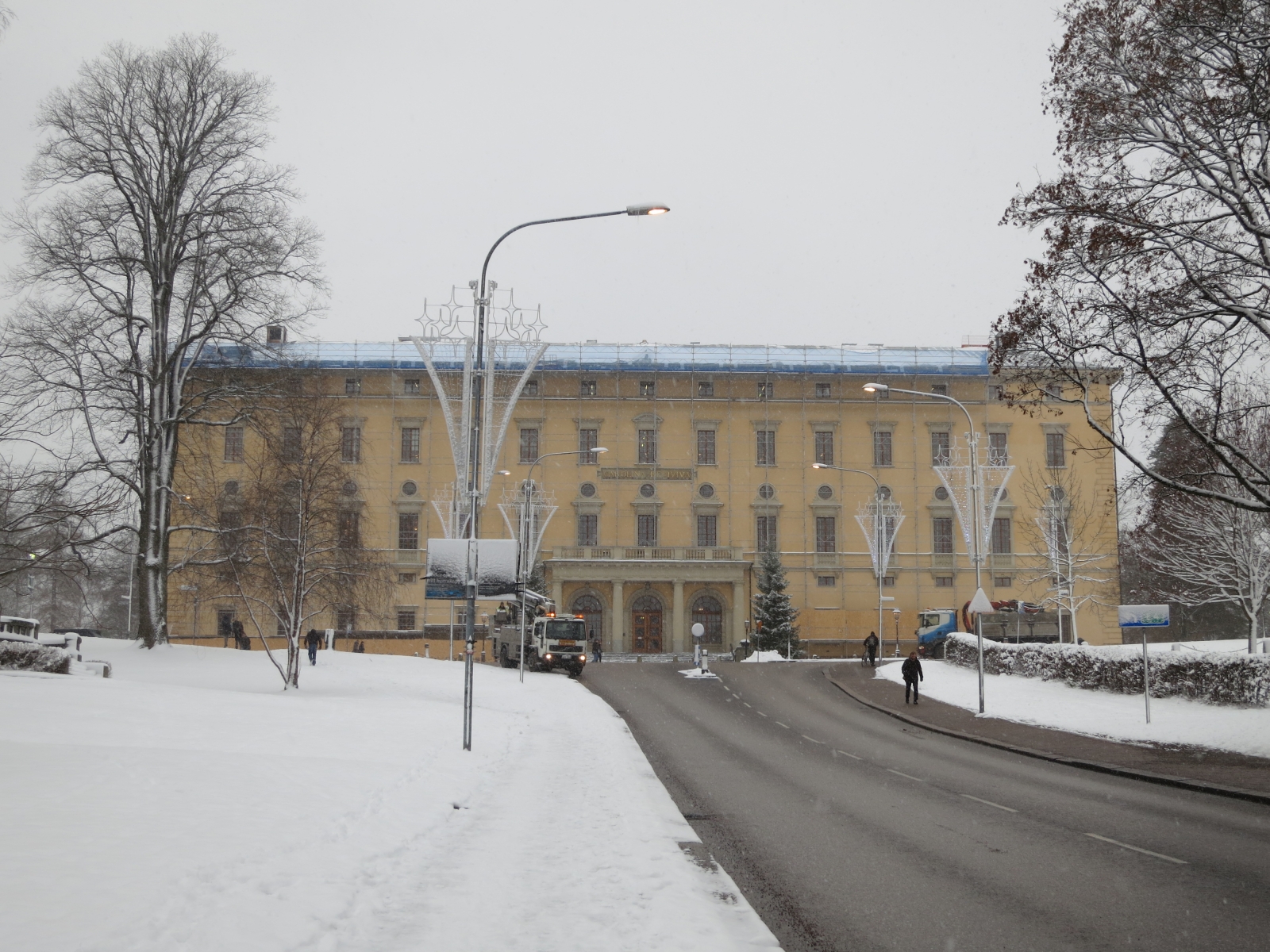 |
| The beautiful Carolina Rediviva building houses the archives. |
After the
performance of the Symphony No. 9 my
Pettersson-immersion session was not over yet. The following day I took the
train to the beautiful city of Uppsala to visit Per-Henning Olsson and the
Allan Pettersson archives.
The Allan
Pettersson archives are held in a secured room in the Carolina Rediviva building.
After checking in my coat and bags, providing my passport information and
signing a lot of papers, I was given access to this tremendous treasure trove
of Pettersson-related material.
As I only had
a few hours I was only able to scratch the surface of everything which was
available. One thing which immediately struck me was how very assiduous
Pettersson was in his record keeping. It seemed like every receipt, every scrap
of paper, every letter, every sketch, every everything, was organized.
He even kept track of his composer peers' salaries. Considering what kind of composer Pettersson was, this (perhaps excessive?) attention to detail is not surprising.
One of the
many highlights of these archives is Pettersson’s sketches for his Symphony No. 2. You can see from his
sketches how he worked out the material which ended up in the
final product. I saw scraps of paper where Pettersson wrote down his notes for
ranges of the different saxophones, in preparation for the Symphony No. 16. And, I held in my hand an original program from
the premiere performance of the Symphony
No. 7, which was of course Pettersson’s breakthrough.
It was a pity
that I didn’t have more time to go through everything (and it’s a pity I don’t
speak Swedish) but any serious Pettersson fan who is ever in Uppsala needs to
visit the archive. It is truly special. Thanks again to Per-Henning for serving as my enthusiastic and knowledgeable guide!
Sunday, December 2, 2012
Hälsningar från Norrköping! (2012)

About 67:40.
One of the big questions regarding the
Symphony No. 9 is performance time, and for those of you who have been waiting
for me to post this review of the Norrköping performance, there is your answer.
I have to admit going into this concert with
a slight sense of worry. Given the extreme demands this work places on the
performers, I was wondering: could they pull it off? Would there be a train
wreck? Would it make “sense” in live performance?
One thing which happened to me while
listening to the performance, which does not happen to me when listening to a
recording, was a real feeling of disorientation during the first few minutes.
Pettersson throws several different (related) ideas at you right from the
beginning, and starts spinning them. However, once I gave into this and just
let the music “be,” I really lost a sense of time and everything sort of just
flowed inevitably to the very end of the piece.
As mentioned above, kudos to Lindberg for
taking literally Pettersson’s performance times and tempo indications. Even
though this performance took about the same time as Francis’ on CPO, I got a
better sense of the music really moving along. Let’s face it, as much as I like
this piece there are some really clunky sections, and in Lindberg’s hands they
never overstayed their welcome; it felt like we were focusing on parts of giant
puzzle, while always keeping in mind the big picture.
The arrival of the climax after the extremely
protracted “spinning” section (one before 78, for those of you with the score)
was extremely well done, a real sense of culmination after a long and
uncomfortable ride. The “Carmen” section sounded less “Carmen”-like and more
shadowy and ghostly, thanks to some truly atmospheric contributions from
percussion. The percussion did a magnificent job, sounding much more confident
here than last year in the Symphony No.
6.
The Norrköping string sections are relatively
small by full-orchestra standards, and I really could have used a lot more
string sound in the performance. This of course can be fixed in the recording.
But an extra special mention for the strings, as they went for it. Like the
percussion, I got a sense of tentativeness from the strings in last year’s
performance of the Symphony No. 6,
but this time around, they dug in an attacked the music. Yes, I could have used
a bigger sound, there were intonation issues and not every note was hit, but
way to go guys!
And of course congrats to Christian Lindberg
for keeping this massive piece together and with a real sense of musical
purpose. Believe it or not, the work got a standing ovation. And guess what is
coming next year in the Pettersson/Lindberg/Norrköping collaboration? Symphony No. 4 and 16!
Subscribe to:
Posts (Atom)